

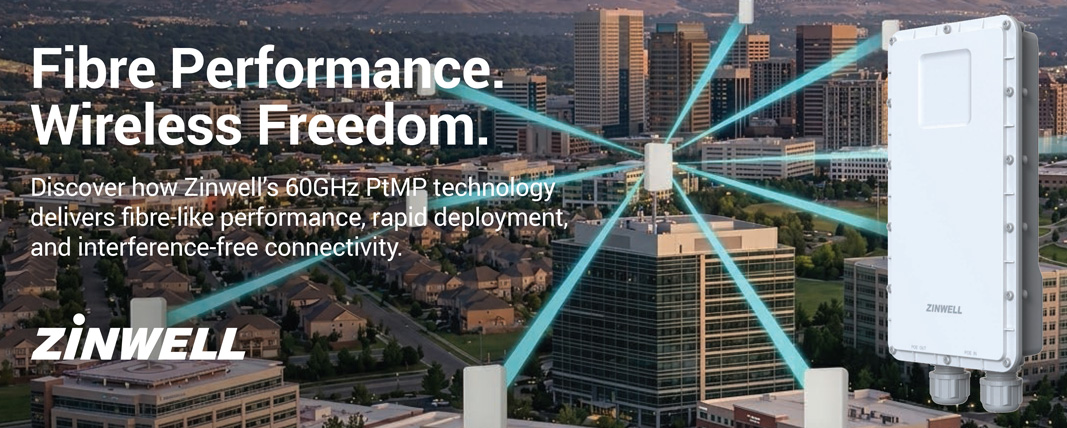
In the evolving landscape of high-capacity networking, a critical distinction is emerging between technology designed for simple user access and technology engineered for robust network infrastructure. As urban environments become denser and bandwidth demands skyrocket, traditional outdoor Wi-Fi 6 deployments are increasingly unable to handle the heavy lifting required for backhaul and distribution.
At Space Technology, we are leading the transition to 60GHz millimeter-wave (mmWave) solutions. By supplying the ICASA and NCRS Approved Zinwell ZWR-V626 60GHz PtMP, we are providing “Wireless Fibre” that offers a foundational shift in how high-performance networks are built. Here is why the ZWR-V626 is the definitive choice for modern infrastructure:
Defining the Role: “Infrastructure” vs. “Access”
A standard Wi-Fi 6 Outdoor Access Point (AP) is designed for Access. Its job is to function as a “Hot Spot,” allowing individual phones and laptops to connect in a park or stadium.
The Zinwell ZWR-V626, however, is purpose-built for Infrastructure. It serves as a high-capacity, dedicated pipe designed to replace expensive, time-consuming fiber-optic cables. It isn’t just a hotspot; it is a backbone capable of carrying the entire data load of an entire building or neighborhood.
Unmatched Precision with High-Gain Beamforming
A major limitation of low-cost Wi-Fi 6 APs is signal degradation over distance due to omni-directional interference. The Zinwell ZWR-V626 utilizes advanced High-Gain Beamforming. Instead of broadcasting signal in all directions, it focuses energy into a precise, narrow beam. This allows Space Technology clients to achieve stable, fibre-like Gigabit throughput over distances that Wi-Fi 6 simply cannot sustain reliably.
Key Benefits of 60GHz mmWave

Infrastructure Replacement
High-capacity wireless fibre for entire buildings or neighbourhoods.
Long-RangePerformance
Gigabit speeds over long distances with precise beamforming.
Interference-Free Spectrum
60GHz band avoids crowded 6GHz WiFi congestion.

Rapid &
Cost-Effective
Quick installation at a fraction of fibre deployment cost.
High-Capacity PtMP: Solving the “Hidden Node” Problem
For Service Providers and System Integrators, Point-to-MultiPoint (PtMP) distribution is where the ROI lives. In outdoor setups, Wi-Fi 6 often suffers from the ”Hidden Node” problem, as more clients connect, data packets collide, and the entire sector’s speed collapses.
The ZWR-V626 PtMP advantage is clear: A single Base Station can serve multiple Subscriber Units (CPEs) simultaneously. Because of the 60GHz directional nature, signals do not “penetrate” or interfere with each other, maintaining peak performance even as you scale your network.
Operating in the “Clean Spectrum
The 5GHz band used by Wi-Fi 6 has become “turbid” in urban areas, leading to unstable pings and dropped speeds. The ZWR-V626 operates in the wide, uncongested 60GHz spectrum. Because the signals are so directional, they don’t interfere with neighbouring links. This allows Space Technology to help you guarantee Gigabit speeds to your customers, a promise that is nearly impossible to keep with standard Wi-Fi 6.
The ROI Story: CAPEX vs. OPEX
While a Wi-Fi 6 AP might have a lower hardware price tag (CAPEX), an experienced System Integrator looks at the total deployment cost. Digging a trench for 100 meters of fibre can cost thousands and take weeks to permit and execute.
The Zinwell ZWR-V626, supplied by Space Technology, can be installed in under an hour. It delivers the same Gigabit performance as physical fibre without the disruption, the labour costs, or the wait.
Frequently Asked Questions:
PtMP is a network architecture where a single “Base Station” or distribution point connects to many separate client stations. Think of it like a wheel (Base Station) connected to many spokes (CPEs). This is the standard deployment architecture for Wireless Internet Service Providers (WISPs) to deliver service from a single tower to an entire neighbourhood.
If you need to provide a reliable, high-speed backbone for multiple buildings or a neighborhood, the ZWR-V626 is designed for that “Infrastructure” role. Wi-Fi 6 is for connecting end-user devices; the ZWR-V626 is for replacing fiber-optic cables.
No. One of the biggest advantages of the 60GHz band used by the Zinwell units is that it is typically an unlicensed spectrum. This allows you to deploy Gigabit-speed infrastructure immediately without the high cost and long wait times associated with licensed frequency bands.
Think of a standard AP like a lightbulb (shining everywhere) and the ZWR-V626 like a laser. By focusing the signal directly at the target, the Zinwell unit reduces interference and ensures that the maximum amount of data reaches the destination without being “drowned out” by other wireless noise.
The ZWR-V626 is designed for high-capacity Point-to-MultiPoint (PtMP) distribution. Depending on your specific bandwidth requirements and environmental factors, a single sector can serve multiple CPEs without the packet collision issues found in traditional Wi-Fi.
Atmospheric absorption and beamforming require precise alignment. If your phone was 60GHz, the signal would drop if you even slightly repositioned your hand. This technology is optimized for fixed wireless infrastructure (links that don’t move),where precise alignment guarantees stability.
No. Due to the very short wavelength, 60GHz signal is almost entirely blocked by walls, dense glass, and foliage. This is another reason it is perfect for dedicated, interference-free outdoor infrastructure. It requires a clear Line of Sight (LoS).